Guide 01 Yorkshire history
Famous Yorkshire inventions and the people who made them
Yorkshire gave the world cement, a cab, a film, a steel and a road stud. This guide sets out what each invention was, who stands behind it and where the story still has loose ends.
Why so many inventors
Ask what inventions came from Yorkshire and the same few names come up again and again. That is partly fame and partly geography. The region combined wool mills that needed better machines, coal that fed steam power, steel works in Sheffield and a dense network of canals, roads and railways. People who solved practical problems there had customers close at hand.
A word of care before the list. Invention is rarely one person at one bench. Many of the items below have rivals, predecessors or later improvers, and local pride sometimes simplifies the story. We say who is credited and what is solid, and we flag where accounts differ.
Joseph Aspdin and Portland cement, 1824
Joseph Aspdin was a bricklayer in Leeds who took out a patent in 1824 for a hydraulic cement made by burning limestone and clay and grinding the result. He called it Portland cement because the set material resembled Portland stone. Modern Portland cement is made differently and at far higher temperatures, so Aspdin's product is best seen as an early step on the road to it. Even so, the patent is widely cited as a starting point for the material that now holds up much of the built world.
Joseph Hansom and the cab, 1834
Joseph Hansom, an architect born in York in 1803, patented a light two wheeled cab in 1834. The design was later reworked by others and became the horse cab that filled Victorian city streets. Its story, including why it is called a hansom, has its own page: Hansom cab history.
Louis Le Prince and Leeds Bridge, 1888
Louis Le Prince was a French inventor who worked in Leeds. In October 1888 he filmed short sequences with a single lens camera of his own design, among them a garden scene at Roundhay and traffic on Leeds Bridge. Surviving frames are among the earliest moving pictures made with a camera of this kind. Le Prince disappeared in 1890 on a journey from France and was never found, which has fed many theories. The film history is more crowded than a single name suggests, so it is fair to call him an early pioneer rather than the only one.
Harry Brearley and stainless steel, 1913
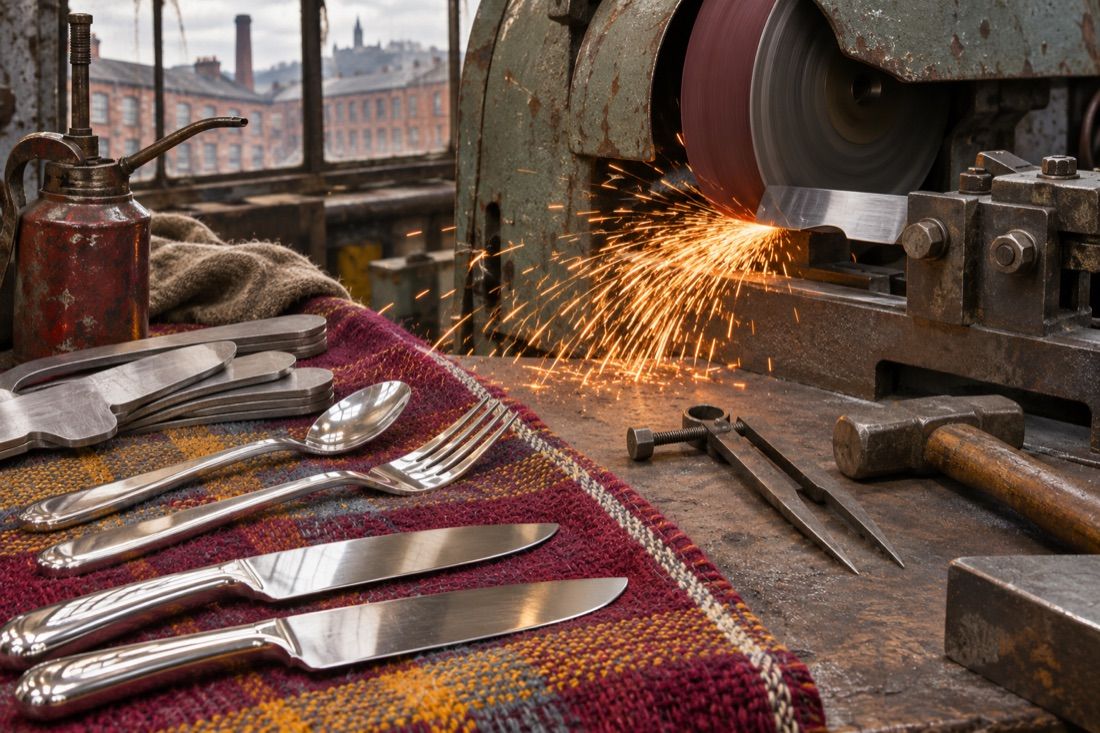
Harry Brearley, a metallurgist from Sheffield, was asked to find a steel that would resist wear in rifle barrels. In 1913 he noticed that one experimental alloy with a high chromium content did not rust like the others. He recognised its value for cutlery and kitchen use, and Sheffield's cutlers became the first to make table knives from it. Stainless steel then developed in several places at once, but the Sheffield discovery is the one the city and its museums celebrate.
Percy Shaw and cat's eyes, 1934
Percy Shaw of Halifax patented his reflecting road stud in 1934. A rubber mounting holds two pairs of glass lenses that throw a driver's headlights back, and the rubber wipes the lenses clean as wheels press it down. The device is still used in many countries. Read the full account in Who invented cat's eyes.
George Cayley and early flight
Sir George Cayley, who lived at Brompton Hall near Scarborough, is often called the father of aeronautics. In the first years of the nineteenth century he separated the problem of lift from the problem of propulsion and described a fixed wing aircraft in a form that looks familiar today. In 1853, by the usual account, a glider of his design carried a man across Brompton Dale. It was a short, one way flight, but it shows the careful, experimental habit that ran through much of the region's engineering.
Other names worth knowing
John Harrison, born in the Wakefield area, built the marine chronometer that solved the problem of finding longitude at sea. Joseph Priestley, born near Leeds, worked on gases and on a way to make carbonated water, using a Leeds brewery as his laboratory. Benjamin Huntsman made crucible steel in Sheffield in the 1740s. Each has a large literature of their own, and each is a good next step after this overview.