Guide 04 Yorkshire history
Saltaire World Heritage Site history: a mill and a model village
Saltaire is a planned industrial village on the River Aire, built around a large mill in the 1850s and inscribed as a UNESCO World Heritage Site in 2001. This is why it exists and what survives.
Why Salt left central Bradford
Titus Salt was a leading Bradford manufacturer of worsted cloth who made his name by spinning alpaca and mohair, fibres that few others were using. By the middle of the nineteenth century his works were scattered over several sites in a smoky and crowded town. He decided to bring them together in one modern, well planned mill on open ground a few miles away, beside the River Aire, the Leeds and Liverpool Canal and a railway line.
The mill and the village
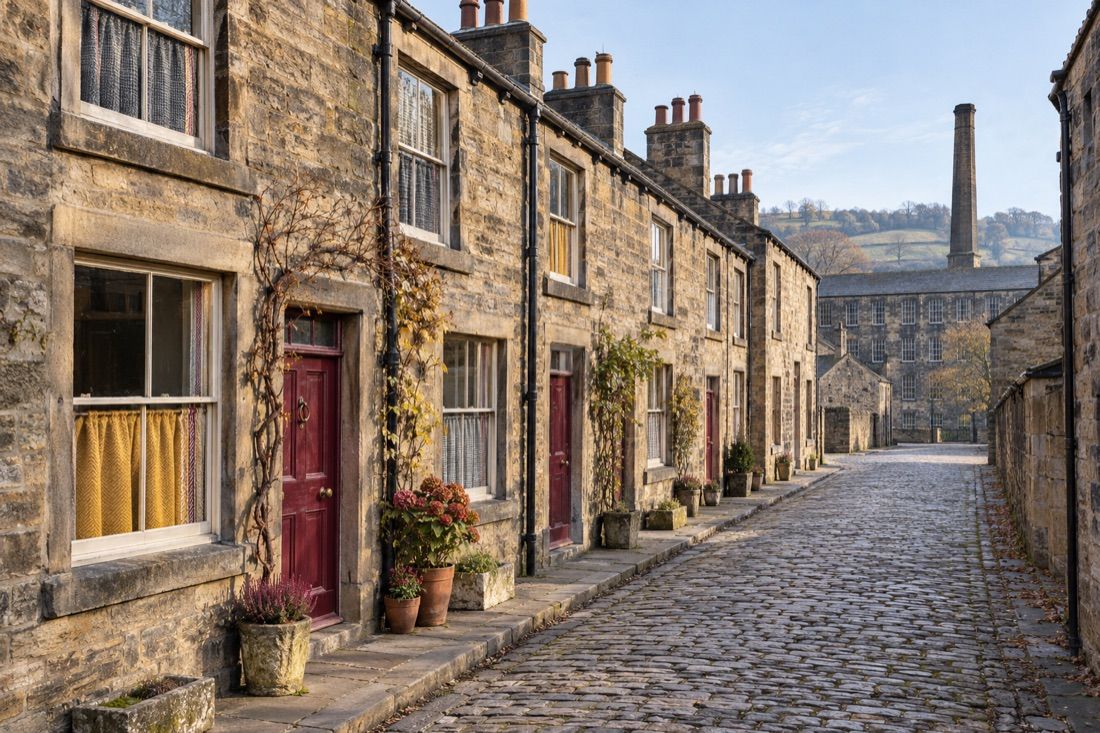
Building began in 1851 and the mill opened in 1853. The village took its name from Salt and the river. It was laid out by architects Lockwood and Mawson in an Italianate style with terraced stone streets, and the houses were meant to be better than the cramped housing of many industrial towns. A church, a school, a hospital, almshouses, baths and wash houses, and later a hall and a park followed as the village grew.
Daily life in a planned village
Saltaire shows both the ambition and the limits of Victorian paternalism. Salt cared about health, education and sobriety, and the village was famous for not including a pub in its early years. It also made workers dependent on their employer for housing and many services. Historians weigh it as a humane experiment and as a form of control at once, and it is best understood as both.
World Heritage status
Saltaire was inscribed on the UNESCO World Heritage List in 2001. The listing recognises it as a complete example of a mid nineteenth century industrial village, whose mill, housing and public buildings still stand together. The site is managed with local authorities, and parts of it are used as homes, shops and workplaces rather than as a museum.
Visiting Saltaire today
Salts Mill has been reused as a gallery, shops and workspace, and it holds a large collection of works by David Hockney. The streets and the canal path are free to walk. Opening times and exhibitions change, so check the relevant websites before you go. For other places that show the industry behind Saltaire, see the industrial museums guide, and for the wider story of wool, read Yorkshire textile mills history.
Why alpaca mattered
Alpaca wool gave Salt's cloth a lustrous, silky finish that set it apart from ordinary worsted. Using it successfully took technical skill in the spinning and weaving, and it is part of why his business grew large enough to justify a whole new site. The village was therefore not only a social project. It was also a factory complex designed for efficient flow of raw material, power and finished cloth.
Reading the layout
Saltaire rewards a slow walk. Streets run in a grid, with the mill at one side, between the canal and the railway, and the housing laid out beyond it in graded sizes for different grades of worker. Streets are named after members of the Salt family and the royal family. Public buildings such as the church and the institute stand on the main axis, and the park lies across the river, so the plan itself tells you what the founder wanted to emphasise.