Guide 05 Yorkshire history
Yorkshire textile mills history: wool, worsted and the West Riding
For about two centuries the valleys of the West Riding were organised around cloth. This guide explains the difference between wool and worsted, how work moved from cottages into mills and how to read a mill building.
Wool before the mills
Yorkshire was a wool region long before the factory. Sheep grazed the uplands, streams gave soft water for washing and fulling, and families spun and wove at home, often alongside farming. Merchants sold the finished cloth in cloth halls such as the Piece Hall in Halifax, which opened in 1779. The factory system grew out of this world rather than replacing it overnight.
Wool and worsted
Two kinds of cloth matter here. Woollen cloth is made from short fibres that are carded and spun into a fuzzy yarn. Worsted uses longer fibres that are combed to lie parallel and spun into a smooth, hard yarn. Bradford became the great centre of worsted, while Leeds and the towns around it were strong in woollen cloth. The distinction explains why different districts built different kinds of mill.
From cottage to mill
Spinning was the first process to move into mills, because machines made it far faster than the hand wheel. Early mills used water power and stood on rivers and streams, so many sit in narrow valleys. Steam engines later freed owners from the water supply and allowed larger mills in towns and beside canals. Weaving stayed in homes and small workshops for longer, then moved into big weaving sheds as power looms improved.
Work in the mills was hard, noisy and often dangerous, and children and women made up a large part of the early workforce. Reform laws on hours and child labour came slowly and shaped how mills were run.
The Heavy Woollen District and shoddy
The area around Batley and Dewsbury is known as the Heavy Woollen District, named for the thick cloth it made. It is also linked with shoddy, a cheap cloth made by tearing old woollen rags back into fibre and respinning them, a trade that recycled material at industrial scale. The word later became an insult, but at the time it was a way to make cloth for a wide market.
Mills as buildings
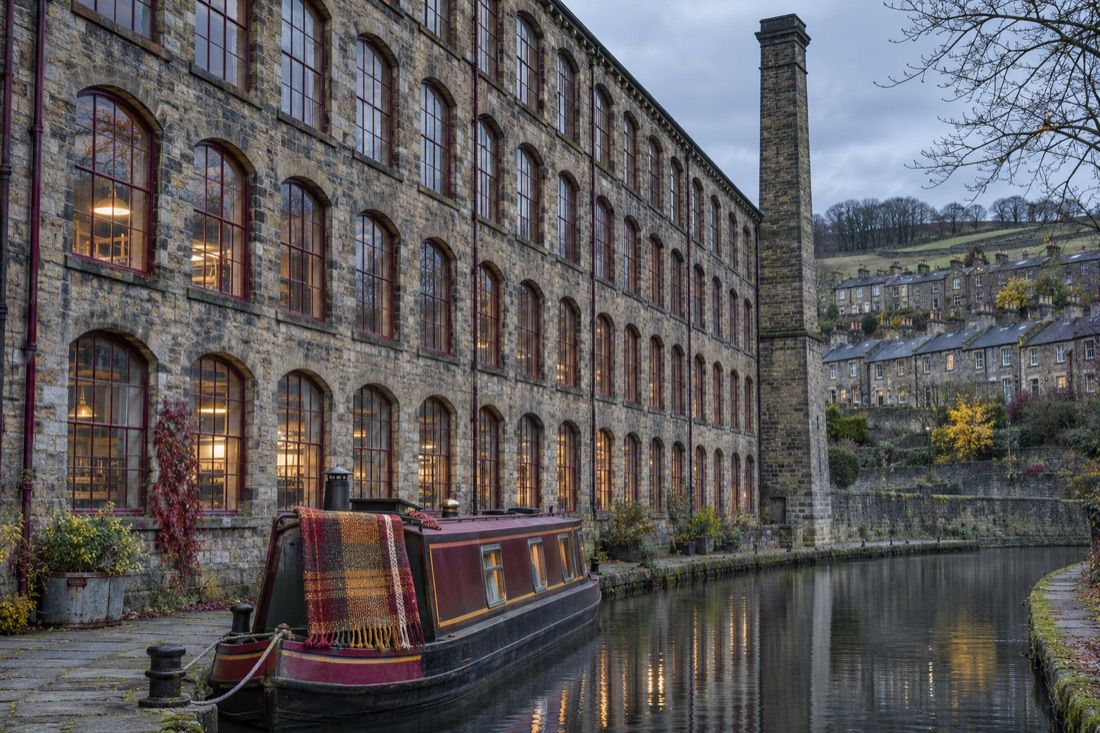
Surviving mills are easy to read once you know the signs. Tall, narrow, multi storey blocks in stone or brick with rows of regular windows were built for spinning and for machinery driven from line shafts. Long, single storey weaving sheds with a saw toothed roof let in even northern light. A square or round chimney marks the boiler house, and a tall engine house or a mill pond points to older power sources. The standard reference for these buildings is the study Yorkshire Textile Mills 1770 to 1930 by Colum Giles and Ian Goodall.
What happened next
In the twentieth century competition from overseas, changing fashions and new fibres reduced the industry, and many mills closed or were demolished. A good number have been reused as flats, offices, studios and museums, which is how most visitors now meet them. See Saltaire for the best known example, and the museum guide for places where you can see working textile machinery.