Guide 03 Yorkshire history
Who invented cat's eyes? Percy Shaw and the reflecting road stud
The short answer is Percy Shaw of Halifax, who patented his reflecting road stud in 1934. The longer answer covers how the device works, why it spread and which parts of the legend are only legend.
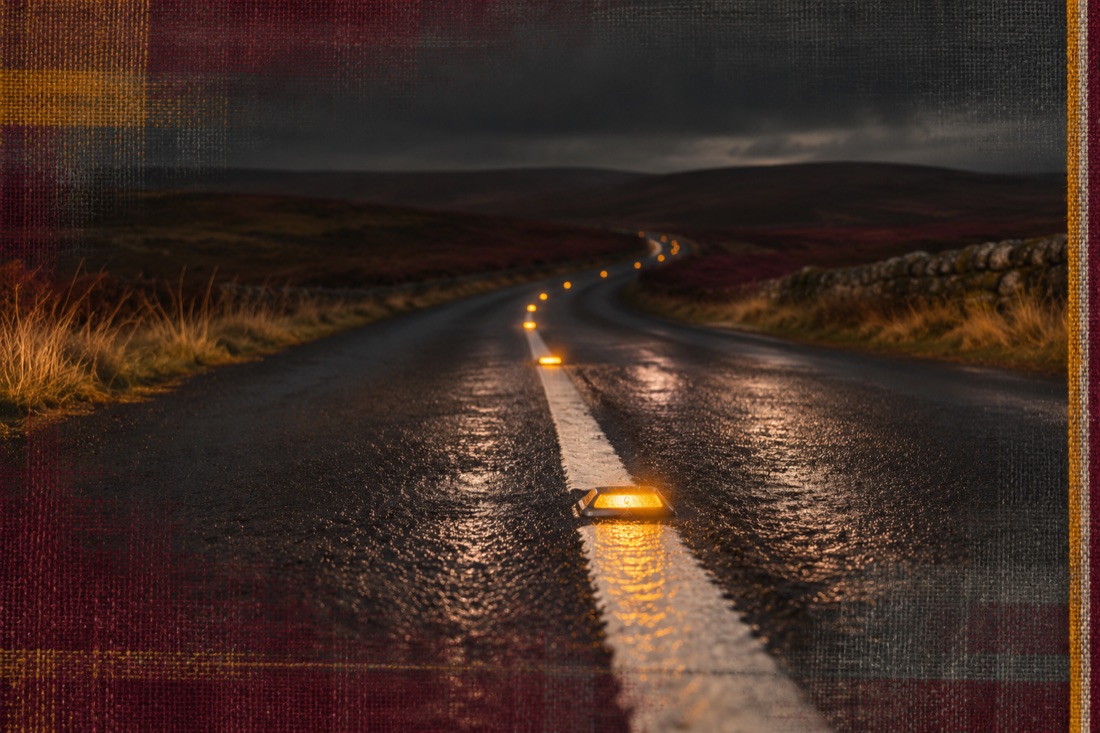
The short answer
Percy Shaw, a road contractor from Halifax in West Yorkshire, is credited with inventing the cat's eye road stud. He took out a patent in 1934 and set up a company in Halifax to make the studs. Cat's eyes sit in the centre of the road and reflect headlights back to the driver, which shows the line of the road on dark nights and in fog.
Percy Shaw of Halifax
Shaw was born in Halifax in 1890 and lived most of his life there. He was later made an OBE and died in 1976. He worked in the road trade and was by all accounts a practical man who kept to his own routines. There is a good deal of folklore about him, so it is worth sticking to what is well established: he held the patent, he founded the business and the product became standard equipment on roads.
How a cat's eye works
A cat's eye is a retroreflector. Two pairs of glass lenses sit in a rubber mounting inside a cast metal housing that is set into the road surface. Light from a vehicle's headlamps enters a lens, is returned by a reflective backing and leaves almost along the same line, which is why the stud shines most brightly to the driver whose lights hit it. Because the lenses are set below the road surface level, they are protected from most traffic.
The self cleaning trick
The clever part is the rubber. When a wheel presses the stud down, the rubber pad compresses and the lenses sink into the housing. As they do, they pass a wiper edge, and in wet weather a small reservoir of rainwater helps flush the glass. The wheel therefore cleans the stud each time it passes. This is the feature that made the design practical rather than just bright.
Why the invention spread
Cat's eyes found their moment in the period of reduced lighting during the Second World War, when road safety and driving in the dark were pressing concerns. In the following decades the stud became a standard part of road marking in Britain and was adopted in many other countries. The basic idea has been joined by studs with solar powered lights and by other types of marker, but the original type is still easy to spot on rural roads.
The legend and the questions
Many people have heard that Shaw was inspired by the eyes of a cat at the roadside, or by reflective tram rails on a foggy night. Shaw himself seems to have told more than one version, so treat both as stories rather than record. It is also often asked whether he became a millionaire. Sources describe him as prosperous, but we have no reliable figure and prefer not to guess.
For other inventions from the region, see famous Yorkshire inventions. Another Yorkshire road story, the cab that ran on city streets in the nineteenth century, is told in Hansom cab history.